
Taking a Fulani Hat on the NewYork Subway
Buying up other people’s culture while staying at home.
On most Saturdays, a flea market pops up under the brick arch holding up the Manhattan Bridge in DUMBO, Brooklyn, on the edge of the East River across from Manhattan. The stalls, clothing racks, and tables mostly sport vintage clothing and trinkets, and music and food stalls add to the bustling atmosphere. Despite the very loud sound of endless car traffic and roaring subways coming across the bridge overhead, this market has a fun, congenial air. Of course, it’s not like the markets I’ve been to in non-Western countries, and when I stopped by I always missed the displays of vegetables, grains, and spices, and all manner of stuff being bought and sold, the little kids offering up trays of unshelled peanuts or chewing gum for sale, and the sounds—a goat bleating here, chickens scratching there. I am also fascinated by all the rescued and reimagined trash—such as battered food cans with the labels still attached, cracked bottles, broken zippers, tossed colorful electrical wires, rubber tires, empty grain sacks—that are transformed into useful objects or art. And I revel in hearing the haggling in languages I don’t know over things I often can’t identify. But still, the DUMBO market is fun, and it sometimes has a few stalls of “ethnic goods” that draw me in.
On Saturday, I saw a painted wooden mask of a woman as I walked quickly through the DUMBO flea market. It was hung on a wire fence overlooking several tables stocked with beautiful African cloths and carved statues. There were also brass figurines and other small items. The mask caught my eye because it was beautiful. A beatific face, somewhat elongated, wearing a headdress that formed the shape of a heart at the top. I walked past the mask several Saturdays before I stopped and asked the stall’s owner how much it costs—$125.
Sure, I could have bought it, but something inside me resisted. It was one of those hidden but powerful uneases that sometimes comes with being an anthropologist. It just seemed wrong to buy this in Brooklyn when clearly it came from Africa. Normally, I only buy things “in country,” that is, where I am right there, often with the creator of the object, and I have a chat about what that item means and how it was made. I don’t just want to own it, I want to know about it—occupational hazard. As a result, Balinese angels are suspended from every ceiling in my place, sometimes in a flock, Balinese puppets guard by bookcases, Australian aboriginal art pops on my walls, Maasai necklaces and earrings are hung with care, Balinese dancers’ headdresses decorate the cat tree, and Murano glass chandeliers light it all up. Although all the travel booty is beautiful in every way, it all has meaning for me because of the experience of purchasing them in place, usually from the person who made that object. They also have meaning for me because they usually represent months-long stays in a different culture, since I was doing research there. Digging into a culture means getting to know its material culture as well.
Everything we make has meaning—spiritual, cultural, artistic, or personal. When I buy something in a foreign place, it’s not just to remind me of an adventure. The object itself, I believe, also has a kind of intimate power. That object represents the story of a person, what they believe in, how they see the world, how their traditions are expressed, and what that object means to them. And when I carry something home, I am bringing back a tiny piece of that person as well as a representation of his or her culture. I do this not just to own, but to enrich my own cultural space, and I do it with the greatest respect and admiration, sometimes even awe, which is what I feel as I stand in my living room looking at Aboriginal art. According to me, buying something in another culture is not just a remembrance but an attachment between people and between cultures, and it feels intimate and deep expression of human connection.
But I also admit that sometimes that interaction is less than honorable. Often, I am the white Westerner buying goods from financially disadvantaged people and going back to my fancy home. It’s always hard to know if I am taking advantage or helping out. For example, I once bought two silver bracelets through a bus window from an older woman in rural Madagascar. The fact that I was in the bus going somewhere I could pay to go, and she was standing there waving her arm at me as a sales pitch felt o.k. at the time, but was it? She’d get money, I’d get the bracelets, but for all I knew, they were all she had. As a Westerner, I am always in the economic driver’s seat, and for all my supposed guilt or respect, I don’t hesitate when I come across some amazing cultural artifact. Deep in my soul, I try to justify a purchase by telling myself they might need the money more than the goods, and that I am probably being overcharged, which helps with the anthropological guilt but doesn’t erase it.
But the reality is, I love this stuff. I love that someone in another culture, one that I really don’t understand fully, is allowing me to hold it, buy it, hang it on my wall, and look at it forever.
The hesitation I had about buying that particular African mask was worse than my usual anthropologist’s conundrum. I was not “in country,” and I didn’t know where it was from, let alone who made it. Buying in Brooklyn felt like some kind of betrayal, or maybe just too “touristy” for me. And yes, I saw the irony in that too—even if I am “in-country,” I am still buying up other people’s culture, often from a shop or flea market, or from someone along the road, where there is also often a middleman or middlewoman proffering the goods. But this felt like more like I was walking into a shop in Manhattan that sold goods from other countries, like a 10,000 Villages Shop or Pier One. Nothing wrong with that, but it would be a transaction, not a meaningful moment. And so, I walked by it again a few more times over the summer.
But that face got to me, and one Saturday I finally decided to bring her home. When I made a special trip to the flea market, the stall was there, but the mask was gone, and I was deeply disappointed. I did ask about it, and the seller suggested another face, but no. We then had a long chat about his business selling African art (he was Mandingo) and his expertise about the items he has on offer. Standing there, I was tempted by the piles of African cloths as he described where they were from. Although beautiful, I wasn’t interested in owning any that I would leave in a closet.
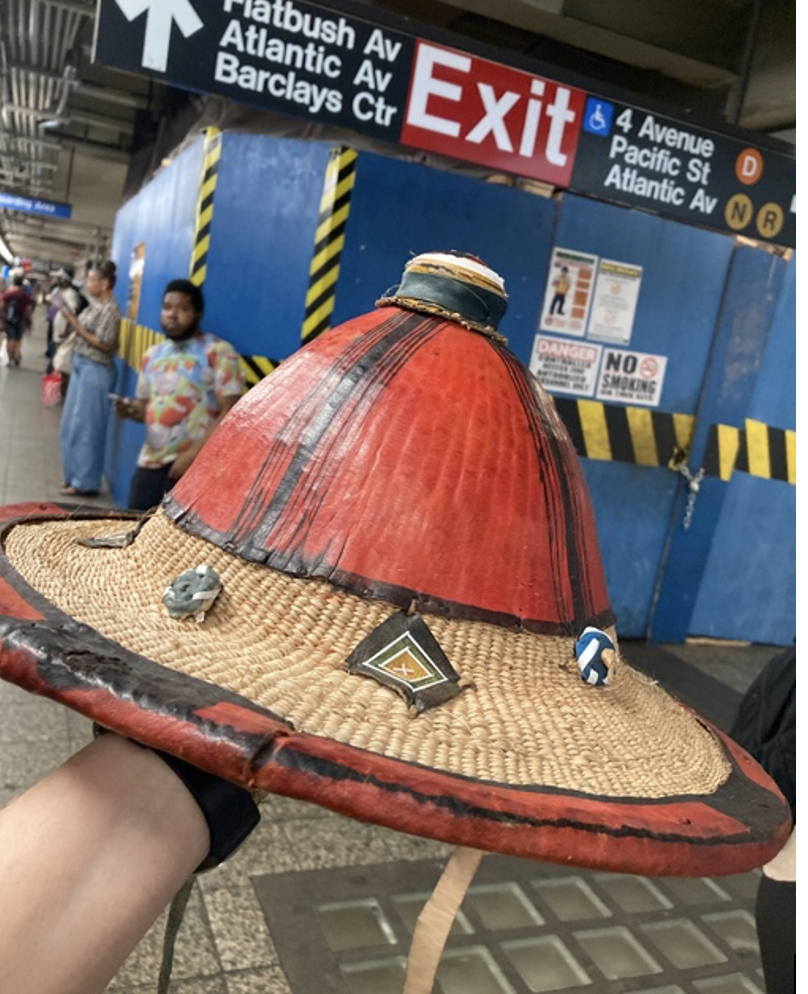
But then I saw the hats. Two typical hats of the Fulani people, a nomadic group four million strong that herds camels and goats along the Sahel region of North Africa, on the southern edge of the Sahara desert. I know about them from the Werner Herzog film “Nomads of the Niger” (which I highly recommend if you can stand Herzog’s weird droning voice) and from various books. Various Fulani subgroups meet up and have a festival where young men adorn themselves with elaborate face makeup and jewelry, and those hats, and dance in a line, making exaggerated facial expressions to show off their eyes. The point is to be attractive to women, who walk quietly by in their somber shawls, evaluating the men, sometimes choosing one for a tryst. The Fulani male-female ritual is so opposite from Western culture that my 20-year-old students always sat in stunned silence when they watched that film.
And so I picked up the hats and talked with the seller about them. Yes, they were made by Fulani, and they had not been worn; they were not used (which I would have preferred). As we discussed my ‘thing” about material culture and being “in country,” he dismissed my apprehension. “What difference does it make?” he wisely said. “Buy it there, buy it here, a Fulani made it.”
And so, I bought one and was thrilled. Although I wished I were on a camel traveling with some Fulani group near the Sahara, I took it home on the New York Subway and wondered how that felt to the hat—not a camel ride but a speeding subway train to its new home. I held it aloft in my hand; surely some people realized it was out of place, but then, this is New York City, which is a revolving circus of strange stuff, and so no one asked me what it was. And then I looked at the handsome young man across from me in his colorful athletic wear and orange running shoes and thought, “He would look great in this hat, and I bet some of the women on this train in their dull business suits would be happy to walk off at the next stop with him.” But I didn’t hand it over. Instead, it hangs on my living room wall where I look at it every day and think of those Nomads of the Niger and hope one day to see them in person and buy a few more hats, but to enrich my own cultural space.
