
My Tuberculosis Story
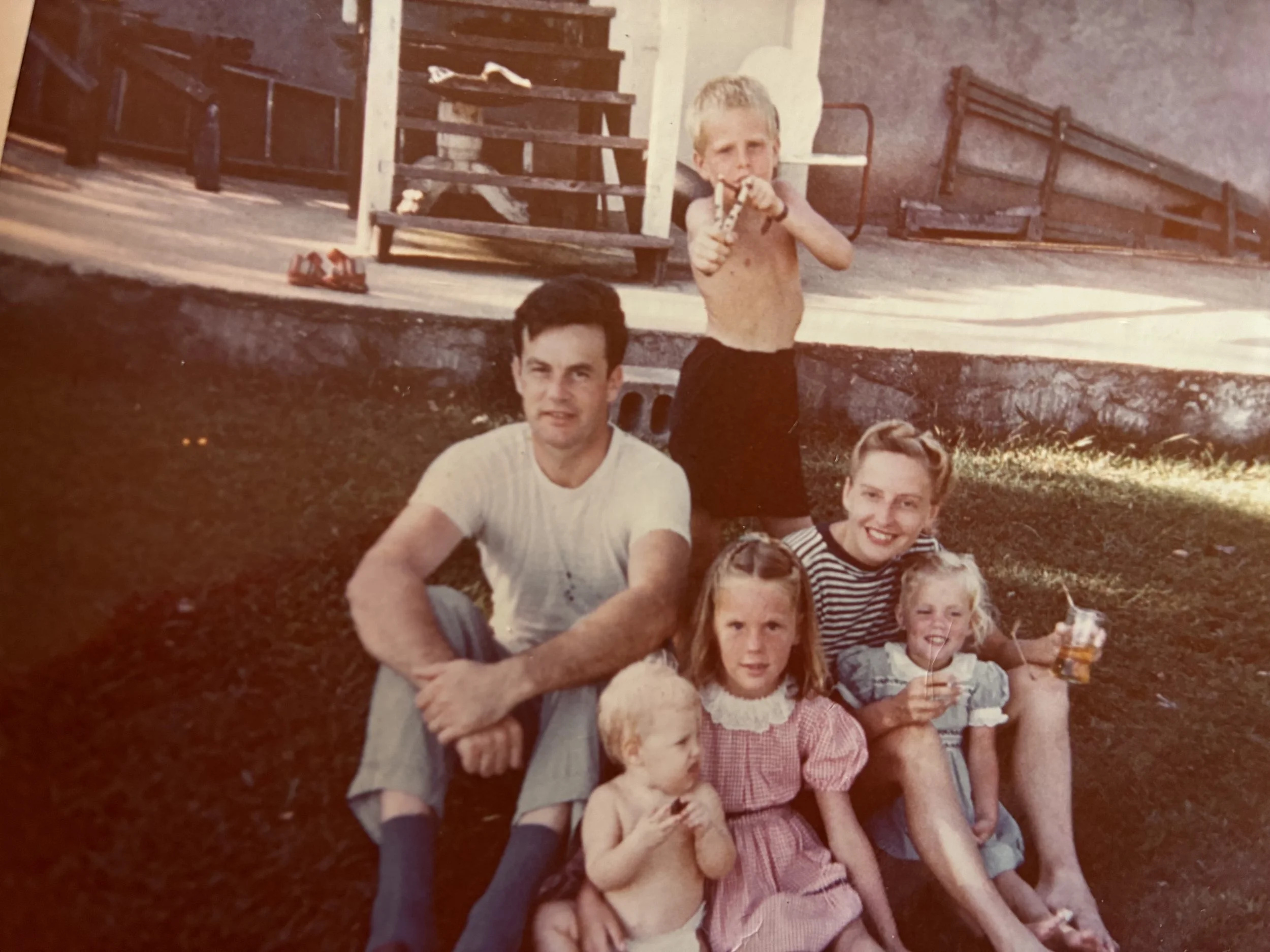
My father had tuberculosis……and I never really thought much about it until this week when I read John Green’s masterful book Everything is Tuberculosis.
As I read the first chapter, my father’s back came into my head, as if he were standing right in front of me, with his back turned. My Dad has been dead since 2000, after a good life, but that back floated into view as I read—defined by a long scar that started about five inches below his neck on the right side and then it curved down and to the right, outlining the pattern of his right lung that was under his skin, flesh, and ribs.
I grew up with that scar, and it was just normal to me, part of my Dad, and I never gave it a thought. Children are masters of normalization; pretty much everything about their parents, good and bad, is a constant presence, just a part of their parents’ identity. It was, in fact, decades before I asked my mother why he had that scar. Interesting that I didn’t ask him—even as a kid, I felt that scar came from some taboo subject and I didn’t want to embarrass him.
It was from TB, sort of.
My father started to get sick in the late 1940s when my parents lived in St. Louis, far from their families in Boston. He was long discharged from the Army Air Corps and employed by Emerson Electric. They had two small children, ages 1 and 2. My mother, as she told me this story, thought his growing fatigue was due to diet, and so she served him lots of salads, which, of course, did nothing. Seeking medical help, the doctor told my mother that my father had lung cancer, and since he smoked at that time, it seemed reasonable. The doctor then operated, but as soon as he opened my father’s back and saw his lung, the surgeon knew it was TB and closed him right back up. Thus, the scar.
Since my mother was alone with two small children, an aunt came to St. Louis to help, and they enacted a plan—to take him “home.” She and my mother got my father and the two little kids on a train back to Boston, where a brother-in-law, a doctor, had found him a place in a sanatorium. According to my mother, her three brothers met the train at the station in Boston and carried my father off on a stretcher, all of them crying because he was a beloved brother-in-law to them. My mother and her two small children moved back in with her parents.
I don’t know how long my father was the “San” but I’ve seen a foto from that time, and there he is tall, skinny, with a moustache, in pajamas. Soon after he got discharged, he and my mother, and the kids returned to St. Louis. And quickly, my mother was pregnant with my sister Andrea, something they did not plan and were not prepared to handle, but they did. Two years later, they had me, so I skipped all the TB years.
From then on, my father received a stipend from the government because they determined he had contracted TB while he was in the Army Air Corp, although he was a stateside MIT-trained aeronautical engineer for the B-17 bomber and never in combat. No trenches, no foxholes, but he had TB. Until he was buried in Arlington Cemetery, with full military honors for being a second lieutenant fifty years previously, he had received a $25 check every year as compensation from the U.S. Treasury for contracting TB in the Army Air Corps.
This is the story I was told, and I never confirmed it with him because it became part of my normalization of him. And I felt he would be embarrassed if I asked. Nobody talked about TB back then, and they don’t talk about it now.
Leap forward 30 years and TB made it presence known again in my family, this time in me. As a Ph.D. anthropology graduate student at U.C. Davis, I collected behavioral data on macaque monkeys in outdoor cages at the California Primate Research Center. Everyone at the Center had to be tested annually for TB because nonhuman primates can easily catch TB from humans, and it’s usually fatal for them. So, every year, I stretched out my arm, turned it to expose the tender underside, and a nurse injected some tuberculin purified protein derivative (PPD) under my skin. If you react, it means you have been exposed to Mycobacterium tuberculosis, the bacterium that causes TB. That spot always turned pink with me, but it was never raised, the definitive positive sign of exposure to the bacteria. As the nurses ran their fingers over my spot, humming and hawing, I’d say, “My father had TB” and they say, “Right.” No one can prove it, but my physical reaction to the test might have been due to some kind of exposure from him, they decided, rightly or wrongly, but I was always given a pass. One of my sisters had the same reaction to a TB test once. As I look it up now, the pinkness is proof of nothing, but for me, the connection with TB, to my father, that test was always sentimental because it brought with it a connection to him beyond my blue eyes and good hair. TB did that.
And so, there is no dying in my story, but there is presence, the ghostly hand of TB interwoven in my upbringing and my adult self. I don’t know if I picked up Green’s book because of it or despite it, but that connection made his book personal, meaningful, and eye-opening for me. I learned that TB is omnipresent on Earth, concentrated mostly in underdeveloped nations that don’t have the means to provide tests, medications, medical care, and sustenance to their citizens. The TB bacteria are also slow-growing bacteria, which gives them plenty of time to become drug-resistant which puts patients in poor countries at a disadvantage because they don’t have access to, or the money for, newly formulated medications. There is a cure, but they don’t get to have it.
To most Westerners with relatively decent health care, TB seems like an “old-fashioned” disease that infected romantic poets, high society women, and artists in the 19th century and then poor people who lived in squalor in the 20th century. TB is neither of those profiles. There are now an estimated 1.7 billion people, almost a quarter of all humans alive today, walking around with latent TB that can become active at any point. And about 11 million people are ill with active TB. But those victims are concentrated in Southeast Asia, the Pacific, and Africa, so who cares, eh?
TB as an illness and cause of death is now a case of the rich versus the poor, and TB knows it. As Green puts it, TB is really a social disease. “You live if you’re rich. And if you’re not, then you hope to get lucky.” And he sums up the impact of this disease: “It’s an illness of poverty that worsens poverty. It worsens other diseases—from HIV and diabetes. It’s an illness of weak healthcare systems that weakens healthcare systems. It’s an illness of malnutrition that worsens malnutrition. And it’s an illness of the stigmatized that worsens stigmatization.” And the worst part is that it’s curable, but only for those in rich Western countries who have the equipment to accurately diagnose the disease and the money to buy the drugs (and yes, we are looking at you Big Pharma) and pass them out while providing adequate medical support.
But even with our advantages, the West is greatly at risk for TB. With the gutting of USAID and walking away from WHO, the killing of the CDC, and the very notion of Public Health, the United States, in particular, has turned the blindest of eyes toward those who live in poorer countries, pretending that viruses and bacteria can’t cross borders or hop on planes and boats. And it seems that our recent and ongoing relationship with all kinds of global infections, such as COVID-19, HIV-AIDS, Dengue Fever, Bird Flu, Ebola, and others, has had no lasting impact on educating us about contagion. Our ignorance about biology, viruses, bacteria, and contagion is self-absorbed, even haughty, and incredibly stupid. As Green observes, “If TB became a problem in the rich world, attention and resources would rain down upon the illness until it ceased to be a problem for the rich, powerful, and able-bodied.”
But the American public in particular is at risk because we are both badly educated about biology compared to other Western countries, and we embrace a social and economic belief system that focuses on the individual. Everyone must and “should” take care of themselves, win or lose. Contrasted with those scary “socialist” Western cultures that provide their citizens with universal health care, we don’t have a semblance of Public Health anymore, as if each of us could take care of our own because we went to medical school and now work in a lab manufacturing preventive medications and vaccines that we are singularly developing only for our individual use. Yet today, as I write this, about 13 million Americans are walking around with latent TB, and in 2023, 9,633 Americans were diagnosed with active TB. But, ya know, it’s all about autonomy, and if I want to take a chance on dying with TB or anything else, you have a right to so, which means you also get to put others, including children, at risk as well.
The best we can do at this point is wake up, get educated, read Green’s book. Pass it along to friends. Maybe we can use some of our easily earned money to help fight TB before it morphs and comes for us once again. Because the viruses and bacteria are thrilled about all this. Measles, polio, TB and other contagious diseases have been laughing out loud at those silly American for the past year, and they are coming for us.
Places to donate to help with identifying and fighting TB in less economically fortunate countries: Doctors Without Borders, Partners in Health, The Global Fund, TB Alliance
