
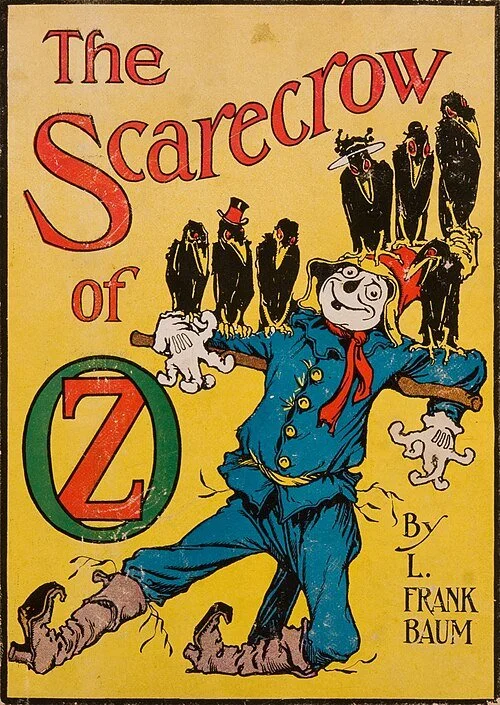
Cover illustration by John R. Neill
I’ve just been reading two important, life-changing books about human consciousness. One is science journalist Michael Pollan’s intriguing book on consciousness, A World Appears, and the other is the original The WonderfulWizard of Oz written by L. Frank Baum in 1900 (followed by 14 other Oz books and then many more written by people other than Mr. Baum). I admit this wasn’t my first Wizard of Oz experience. I’ve read this first Oz book many times. I did so as a child (my family had them all), and then again when I read them to my small daughter. But this time I was reading the first OZ book in Italian (for language practice, after all, I know the story), and let me tell you, it’s even more magical in that language.*
The intersection between Pollan’s book and TheWonderful Wizard of Oz happened early on when I was struck by a conversation between Dorothy and the Scarecrow she found stuck on a pole in a corn field. Here’s their existential conversation about the human brain (and I am using the English version because no one would ever hire me as a translator of Italian or any language):
Scarecrow: “I cannot understand why you should wish to leave this beautiful country [OZ] and go back to the dry, gray place [as Dorothy had described it] you call Kansas.”
Dorothy: “That’s because you have no brains. No matter how dreary and gray your home areis, we people of flesh and blood would rather live there than in any other country, be it ever so beautiful. There is no place like home.”
What a put-down. Dorothy can’t just say, “There’s no place like home.” Oh no. She has to call him brainless. And by shutting him down, Dorothy is basically saying, “You are not human and therefore don’t really think. So, no one should trust what you say.” She does not directly address consciousness, but I am guessing even with her human self-importance she should have recognized that a scarecrow who can dance and figure out how to fool a troop of evil flying monkeys is probably smart, smarter than she is, and therefore conscious.
To define consciousness, Pollan uses the words “subjective experience” (whatever that means) or awareness (whatever that means), adding nothing to this whole issue, seems to me, and I am considered a conscious being, I think. Pollan has also decided that a conscious being has sentience, meaning being able to feel things. The. Scarecrow scores a “yes” on all these. Have you not seen him dance for joy in the movie? He is also fearful of the Cowardly Lion and the flying monkeys. And he loves Dorothy and proves it over and over. He’s sweet and kind and aware of all the dangers in their path.
The Scarecrow also has reactive emotions and discriminatory powers. He knows not to be afraid of Toto as opposed to the Wicked Witch of the West, seems to know Dorothy is basically a good person, and is loyal to her. He knows the difference between the Cowardly Lion and other lions that might rip him apart. He is also emotionally attached to Toto, the Tin Man, and the Cowardly Lion. He protects the group, comes up with all sorts of cleverly deceptive plans, and eventually ends up an advisor to Ozma, the ruler of Oz (later book). He also wants to fix his inadequacies, and he does so by meeting the Wizard and stepping up to the plate to fulfill his outsized demand for the Wicked Witch’s broomstick.
And he is self-aware, as in, “I know that I am.” He is judgmental of himself and others. For example, he thinks he is mentally limited, dumb even, because his head is full of straw and not brain cells. But he also knows he is alive and awake all the time. Given that anomaly, he stays up all night protecting others. We refer to him as male. You’ve seen him thrilled to get down from that pole in the corn field and dance with joy. And you’ve seen him cower in fear as the monkeys land.
I would also like to point out that the Scarecrow has eyes that see and a mouth that talks about things he sees. He has feet that walk and hands that wave around. Sure, his brain is a bunch of straw, but so what? Ours is made up of a bunch cells. The Scarecrow is also no inert rock nor a sun-loving plant that Polan muses might be able to think and feel. He’s way past that.
But maybe I think of consciousness differently than Pollan. I believe that consciousness is knowing in our heads many of the things we do — we experience what’s going on in our bodies, within our sight, hearing, or from our very chatty memory bank, and then internally talking about it. Let me also ask this: What is consciousness to someone born deaf, mute, and blind but with a regular brain? And how much operating brain do you really need to be conscious? Monkeys and apes with smaller-than-human brains are clearly conscious as they keep track of each other, exploit each other, and can navigate a forest or savannah with natural acumen. And you can’t form a complex social primate hierarchy or live in a social group without high-end consciousness and self-awareness.
Seems to me that consciousness is simply knowing that one exists and figuring out ways to stay alive, sometimes relying on others, and following a yellow brick road to a goal. And the Scarecrow can follow a yellow brick road without a GPS.
But then I’m not sure I have Polan’s argument or explanation in play here since I got really bored with his book and quit reading it halfway through. It seemed like an undirected ramble through a dark cave for no good reason, only to find out that it’s a blind cave and we’ll never get out unless we back out and quit thinking about this stuff. In contrast, Dorothy gets back to Kansas with the help of men made of straw and tin and a talking lion. And she almost misses her chance to return home because of a bumbling, fumbling old man who has had a psychotic break and thinks he’s a wizard.
So, here’s what I have to say to Mr. Polan about the Scarecrow. The Scarecrow is a conscious, aware, and sentient being since he interacts with others, talks a lot, and manages to stay alive while being burned, torn apart, and scared. A dog likes him. And he’s a really good friend.
*And I’ve seen the movie a million times, of course.
